

Enterprise AI is the use of artificial intelligence within business processes to improve decisions, create useful outputs, or carry out work. It can help a team predict demand, read documents, draft replies, or coordinate tasks across systems. However, these jobs do not all need the same kind of AI.
Consider a hypothetical Indian distributor with three problems. Stock runs out without warning. Customer emails pile up. Staff spend hours checking orders across separate systems.
A vendor might offer one “AI platform” for all three. Before buying it, you need to separate the jobs. Predicting next week’s sales, writing a reply, and changing an order each call for different tests and controls.
To assess the proposal, ask what each system does and what happens when it gets things wrong.
Enterprise AI starts with a business task
The word “enterprise” describes the business setting. A useful system combines AI with data, access controls, existing software, and people who own the result.
For example, a sales forecast has little value if purchasing staff cannot use it when placing orders. A polished draft reply can also cause harm if it cites the wrong refund policy. Therefore, assess both the model’s output and the process that uses it.
Start by writing the problem without mentioning AI. For the hypothetical distributor, that might be: “We need to identify likely stock shortages before placing our next order.” This gives you something to test. By contrast, a request for a chatbot names a tool before it defines a need.
Sometimes a fixed rule or a better search screen is enough. If the process simply routes orders above a known limit for approval, ordinary software may do the job. Enterprise AI should earn its place against that simpler option.
Understand enterprise AI terms and how they overlap
AI is the broad field. Machine learning is one approach within it, and deep learning is a form of machine learning. Generative AI describes a capability; an agent describes how a system pursues a task. As a result, one product can involve several of these concepts.
IBM’s explanation of AI, machine learning, and deep learning describes how these concepts relate.
Machine learning finds patterns in examples
Machine learning uses data to learn patterns. For example, past sales, prices, and delivery records could help a model forecast demand. You would then test its forecasts using records excluded from its training data.
However, past patterns may no longer hold. A new sales channel or a supply shock can change the relationship between past sales and future demand. Ask how the team will detect weaker results and decide when to review the model.
Deep learning handles complex inputs
Deep learning uses neural networks with multiple layers. It can learn useful patterns in images, speech, and text. For instance, a system could examine product photos for signs of damage.
Because deep learning sits within machine learning, a proposal may correctly use both labels. Teams can assess existing models for their task before deciding whether they need to train one from scratch.
Generative AI produces content
Generative AI creates outputs such as text, images, or code. A language model could draft a response from an approved policy and the details of a complaint. However, fluent wording is not proof that the answer is correct.
The NIST Generative AI Profile identifies confidently false content as a risk. Therefore, decide how staff will check important outputs before customers or colleagues rely on them.
Agents choose steps and use tools
An agent can use tools and feedback to work toward a goal. For an order query, it might check the delivery status and use the result to decide what to do next.
Not every automated sequence is an agent. Anthropic distinguishes predefined workflows from agents that direct their own tool use. The key question is how much freedom the system has to choose its next step.
Match enterprise AI approaches to each problem
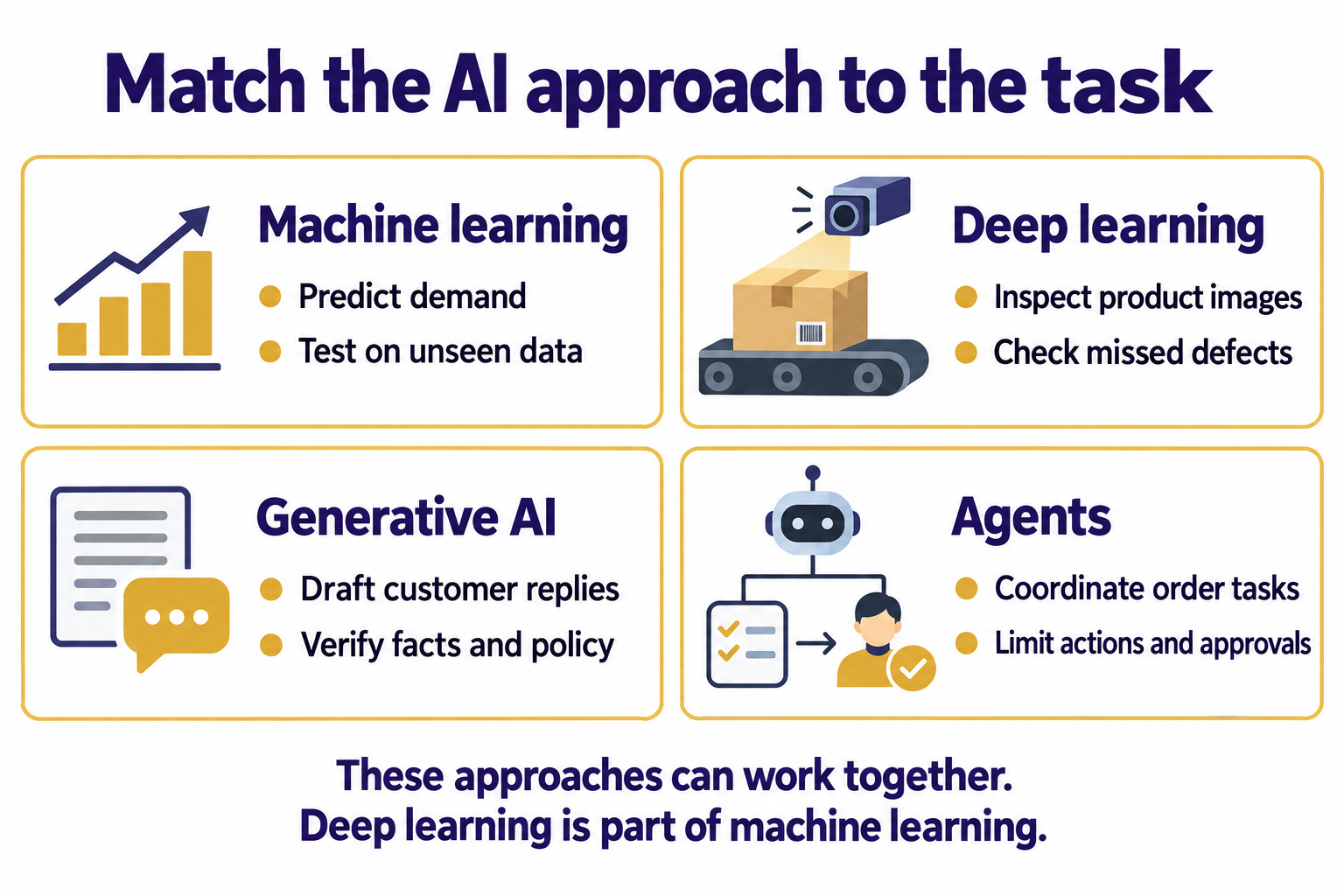
For the distributor, the following options give the team a starting point for testing. The choice depends on its data and the results of those tests.
| Business task | Approach worth testing | Main question before deployment |
|---|---|---|
| Predict stock shortages | Forecasting or machine-learning model | Does it beat the current forecast on unseen data? |
| Inspect product photos for damage | Image model using deep learning | Which defects does it miss or wrongly flag? |
| Draft customer replies | Generative AI with approved source material | Can staff check the policy and order details? |
| Resolve a multi-step order issue | Fixed workflow, or a bounded agent if needed | Which actions need approval, and can mistakes be reversed? |
These methods can work together. For example, a workflow might retrieve an order, ask a model to draft an explanation, and wait for approval. You need not give an agent broad access just because one step uses generative AI.
Also separate the technology choice from the value claim. Faster output may save little time once you include review and correction. For a broader business case, see our guide to the four AI economic value engines.
Define controls before expanding enterprise AI autonomy
Ask what the system may read, suggest, and change. Reading an order is different from issuing a refund. Likewise, drafting an email is different from sending it.
For the distributor’s first trial, staff could review every proposed customer message. The system would have no permission to change orders. Later, the team could consider narrow actions if testing supports them and reliable controls exist.
However, a review button alone does not ensure meaningful oversight. Reviewers need enough time, context, and authority to reject the output. They also need a clear escalation process for cases the system cannot resolve.
Enforce access limits through software permissions. Prompt instructions alone cannot enforce those limits. Keep records of consequential actions and name a person who can pause the service. Our responsible AI guide explores the wider governance questions.
Write a one-page brief before choosing a tool
Your first enterprise AI proposal should answer five questions:
- What specific task needs to improve, and who owns it?
- What data may the system use, and is that data fit for the task?
- What simpler method will serve as the baseline for comparison?
- How will you measure quality, time, cost, and harmful errors?
- What must trigger human review or stop the trial?
Test the proposal on a narrow, representative set of cases before expanding it. Include difficult cases alongside routine ones. Then compare the whole process with the current one, including review time and the cost of mistakes.
Use the brief to agree on what the trial must demonstrate before you fund a wider rollout.

