


Machine learning for business starts with a question your team needs to answer before it acts. Which orders might arrive late? How much stock should a branch carry? Which service requests need attention first?
Consider a hypothetical Indian distributor whose dispatch manager checks a spreadsheet each morning. She knows which routes often run late. However, as orders grow, she can’t review every shipment with the same care.
A model might help her rank the orders that need a closer look. But a risk score won’t fix a missing truck or persuade a supplier to dispatch sooner. Someone still needs to use the score to make a useful decision.
That distinction gives you a practical way to judge an AI proposal. Before asking which model to buy, define the decision, the available evidence, and the action that could follow.
What machine learning for business actually does
Machine learning finds patterns in examples and uses them to produce outputs for new cases. In supervised learning, those examples include known outcomes. A delivery model could learn from past orders and whether they arrived on time.
The inputs might include route, order size, dispatch day, and supplier history. The outcome you want to predict is the label. Google’s introduction to supervised learning explains how these inputs and labels support training and evaluation.
Two common tasks are classification and regression. Classification predicts a category, such as late or on time. Regression predicts a number, such as expected delivery time. Neither output guarantees what will happen next.
Other methods look for groups or unusual patterns without using a known outcome for each example. However, a cluster of similar customers doesn’t explain why they behave alike. Your team still has to investigate whether the pattern matters.
Machine learning is part of AI, and deep learning is part of machine learning. These terms describe overlapping capabilities. Our enterprise AI guide explains the broader map.
Start with the decision, then compare the alternatives
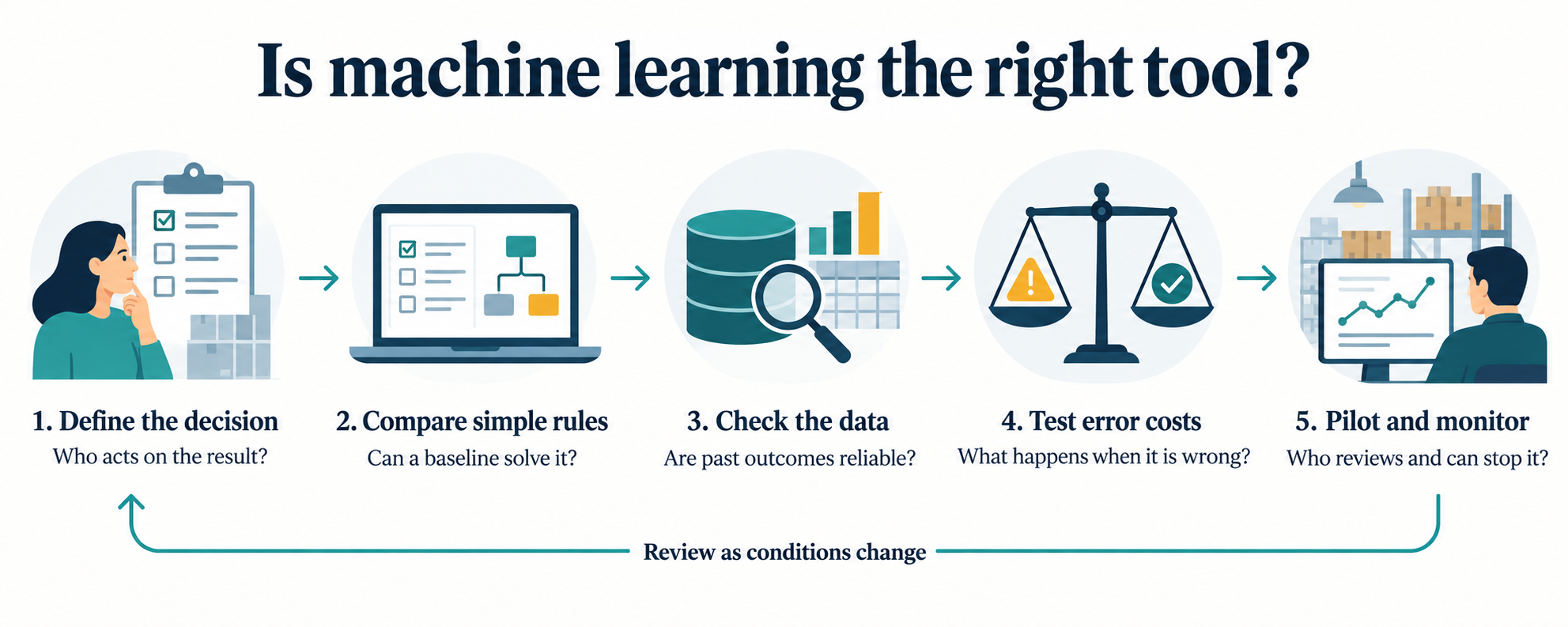
Write the proposed use in plain language: “Help the dispatch manager choose which orders to check before noon.” That statement is more useful than “Build an AI logistics platform.” It names a user, a task, and a deadline.
Next, ask what the team does today. Perhaps staff flag every order from a supplier with repeated delays. That rule becomes a baseline: the approach a new model must beat.
Rules can be enough when the conditions are clear and stable. For example, a simple check can flag an order with a missing delivery address. Google’s Rules of Machine Learning recommends starting without machine learning when simpler methods can do the job.
Machine learning for business becomes worth testing when several factors interact and fixed rules miss useful patterns. Still, complexity brings costs. Include data preparation, software integration, staff review, and ongoing checks in the comparison.
Also separate prediction from writing. Estimating which order will run late differs from drafting an apology to a customer. A business may use predictive models for the first task and generative AI for the second. Each needs its own test.
Check whether the history can support the prediction
For supervised learning, you need examples with outcomes you can trust. In the distributor example, “late” must mean the same thing across branches. Is it arrival after the promised date, the agreed time window, or a revised commitment?
If teams record those events differently, resolve the definition before training. Otherwise, the model learns from conflicting answers. The AI data readiness checklist covers ownership, quality, and access checks that help here.
Then inspect what staff knew at the moment of prediction. A field entered after delivery cannot fairly help a model predict a delay beforehand. Ask the technical team to show that every input would exist when the live system needs it.
Testing also needs fresh cases that the team didn’t use to train the model. For a delivery pilot, ask for a test using orders from a later period. This more closely reflects the task of applying past patterns to future orders.
Finally, check the range of cases. Strong results on familiar routes may not carry over to a new region or supplier. Machine learning for business needs evidence from the conditions where people will actually use it.
Measure the cost of prediction errors
A model can make two different mistakes in the delivery example. It can flag an order that arrives on time, creating an unnecessary review. Or it can miss a delay, leaving the team without time to respond.
Those errors have different costs. Because review capacity is limited, the dispatch manager needs to know how useful the flagged list will be. She also needs to know how many late orders the model misses.
Precision measures the share of flagged orders that actually arrive late. Recall measures the share of all late orders that the model flags. Google’s guide to classification metrics explains why accuracy alone can mislead, especially when one outcome is rare.
For the pilot, agree on the acceptable trade-off before reviewing results. Include the number of orders staff can investigate and the time each review takes. A technically better model may still be impractical if its alerts overwhelm the team.
Keep the business outcome separate from the model score. Finding likely delays is useful only if earlier action improves delivery or customer handling. Compare the complete workflow with the existing process, including the extra work it creates.
Plan a machine learning for business pilot
Start with one team and a limited use. Let staff review predictions before they change customer commitments. Record whether they followed the recommendation, what they did, and what happened afterward.
Name a business owner who can decide whether the workflow helps. Also name a technical owner who checks data feeds and model performance. If either role is unclear, resolve it before widening the pilot.
Agree on conditions that trigger review or a pause. Missing inputs, an unusual surge in alerts, or worsening results should prompt investigation. Keep the previous process available while the team diagnoses the problem.
Don’t assume the model stays useful because it passed its first test. Suppliers, routes, and working practices can change. Set a review schedule that fits the pace and consequences of those changes.
Before approving machine learning for business, ask for a one-page pilot brief: the decision, baseline, data, error costs, owners, and stopping rule. If the team can’t complete it, clarify the proposal before committing to a model.

