


NLP for business can help a team sort an inbox before anyone writes a reply. The value starts with finding out what each customer needs and sending the request to the right person.
Consider a hypothetical appliance seller in Hyderabad. Its service team receives messages about late deliveries, repairs, and billing errors. Some customers write in English. Others use Telugu, Hindi, or a mix of languages in the same message.
Before routing a request, staff must read the note and find its order details. A missed detail can send a repair request to billing, adding another delay. This is a useful starting point for natural language processing, or NLP.
What NLP for business actually does
NLP is the field of computing that works with human language. It covers tasks such as sorting text, finding names and dates, translating, and generating language. Systems can use rules, machine learning, or deep learning to do this work. IBM’s introduction to NLP explains these approaches.
The output need not be a paragraph. For example, the appliance seller could use a repair label and an order number. Staff can then check both against the original message.
This also explains why NLP and generative AI overlap without meaning the same thing. Generating a customer reply is a language task. So is sorting messages into queues, even when the system writes no new prose.
Before choosing a tool, name the result you need. Do you want a label, a set of fields, a short summary, or a draft reply? Each result needs a different test. Our guide to generative AI for business covers the checks needed for generated text.
Split the job into tasks you can check
Start with classification: assigning text to defined groups. A message about an unpaid refund might receive a billing label. However, a note about a broken appliance could need both a repair label and a refund label.
Therefore, decide whether the tool may assign more than one label. Also give it a route for unclear messages. Forcing every note into one group can hide cases that need a person to read them.
Extraction is a separate task. It pulls details from the text into fields, such as a date or product name. Named entity recognition identifies items such as people, places, and organizations. However, order numbers may need custom rules or a model adapted to your records.
For example, a message might mention two order numbers: one for an earlier purchase and one for the item needing repair. Finding both numbers does not prove the tool knows which one belongs in the service ticket.
Sentiment analysis estimates the tone expressed in text, often using labels such as positive or negative. It does not establish the urgency of a request. A calm report of a smoking appliance still needs prompt review, even if the model finds little negative language.
Microsoft’s language-service overview describes features including text classification, entity recognition, and sentiment analysis. Treat these as separate capabilities when reviewing a supplier’s demo.
Test NLP for business in your customers’ languages
A clean English demo is a weak test for an inbox full of mixed-language messages. Build the trial around the text your team actually sees.
Include spelling errors, short fragments, local product names, and words written in a different script. For instance, Hindi typed in Latin letters may differ from the Hindi text a supplier used in its tests. Ask what evidence supports each claimed language capability.
Also include messages with more than one issue. A customer may report a late delivery and ask to change an address. Staff need to decide whether the tool should create two tasks or route the whole note to one owner.
Negation, which changes a statement’s meaning with words such as “not,” needs its own check. An invented test message such as “The fridge is not cooling, but the light works” contains two facts. The working light should not cause the system to mark the appliance as working.
Keep the original text beside the suggested label and extracted fields. If a translation is part of the process, test that step too. Otherwise, a later model may receive a changed meaning and produce a plausible result from the wrong input.
Before using customer records, confirm who may access them and what the service retains. Remove details the trial does not need. Our AI data readiness guide sets out the preparation checks.
Measure errors by the work they create
To assess NLP for business, ask staff to label a sample of messages before testing the tool. Use written rules so that two reviewers can resolve disagreements. Otherwise, an unclear label scheme makes it hard to tell whether the model or the task definition needs fixing.
Then keep a separate test set that the team has not used to tune the system. Include routine messages and the rare cases the team most needs to catch.
For routing, count how often messages reach the wrong queue. Also count how often a repair request goes undetected. A tool that performs well on common delivery questions could still miss the cases that matter most.
For extraction, compare the order number and date with the source message. Distinguish a missing detail from one the tool failed to find. These failures need different responses.
Finally, measure the time from receipt to a correct handoff, including staff corrections. A fast label adds little value if another team must read and reroute the message later.
Start with routing suggestions, then expand
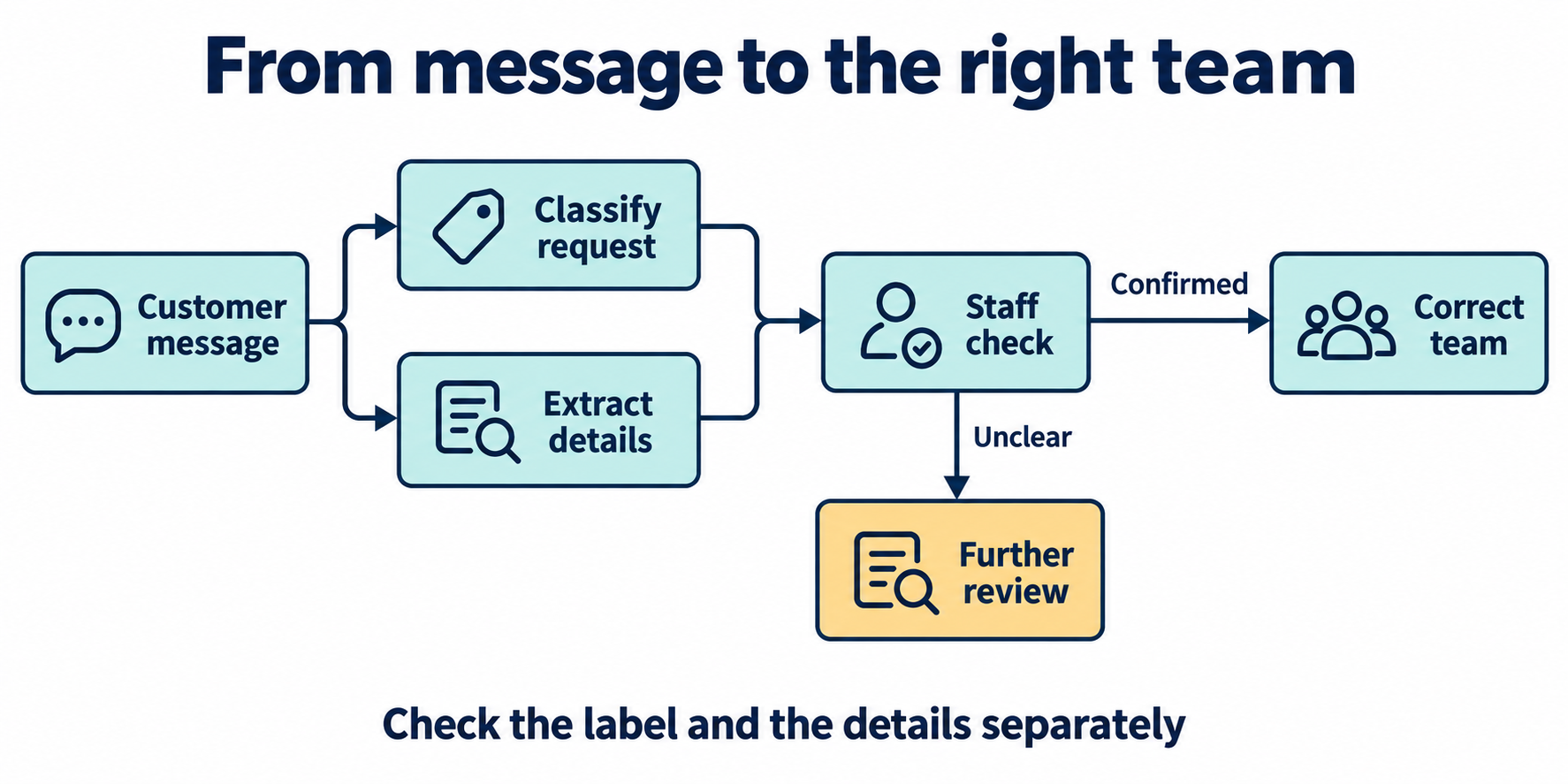
For the first NLP for business trial, let the tool suggest a queue while staff keep control of the handoff. Record their corrections and review why the system made each error.
The service manager should own the label rules and escalation process. A technical owner should track failures and changes to the model. Give staff a clear way to flag new product names or requests that do not fit the current groups.
Some tasks may need only a simple rule. A fixed order-number format, for example, may be easy to find with a text pattern. Compare that baseline with a model before accepting a more complex design.
As the trial progresses, check results by language and request type. Expand automatic routing only where the evidence supports it, and keep a human review route for unclear cases.
NLP for business is useful when language becomes a record or task that someone can verify. Start with one queue, clear labels, and a test set drawn from real working conditions. For help choosing the underlying approach, read our machine learning for business guide.

