

An AI native enterprise does more than buy new tools. It changes how work gets done, how choices are made, and who remains in control.
Many firms now use copilots, virtual assistants, models, and smart dashboards. Yet their core work often stays the same. Staff follow the same steps and seek the same approvals. AI merely helps them move a little faster.
That use improves efficiency within the old model. Transformation changes the model itself.
Indian leaders should therefore ask a harder question: Has AI changed how our company works?
AI Adoption and AI Transformation Are Different
An AI-using firm adds a tool to an existing process. For example, it may give staff a writing aid or place a risk score on a manager’s screen. The old workflow stays intact. The model provides support.
By contrast, an AI native enterprise redesigns the work itself. Models handle suitable routine cases within clear limits. People focus on judgment, unusual cases, key ties, and system design.
Good design keeps people in the decision and makes human responsibility clearer. It states when a person must approve, review, override, or stop the system.
Recent evidence backs this view. McKinsey’s 2026 State of AI survey placed only 6 percent of those surveyed in its group of AI high performers. Yet that group was 3.3 times more likely to seek deep business change through AI.
Leadership intent and execution ability now separate high performers because access to models is widely available.
Four Signs of an AI Native Enterprise
Four practical signs can show where a company stands. Together, they reveal whether AI is still a set of projects or part of the firm’s way of working.
1. Decisions Flow in a New Way
In an AI-using firm, a person makes the choice and asks a model for advice. In an AI native enterprise, the model may handle routine cases. People watch the process and resolve the hard ones.
Take a loan process. A basic use of AI may give an officer a risk score. Yet each request still moves through the old manual steps.
A redesigned process works differently. Low-risk cases can follow a controlled path. Meanwhile, staff study cases that are unclear, rare, or high impact.
The second design may create far more value. However, it also needs firm limits, clear escalation rules, and a named owner.
2. Each Transaction Improves the Data
Many firms collect data mainly for reports. The data tells them what happened, but it does not improve the next choice.
An AI native enterprise builds feedback into daily work. Results return to the data system. Teams check whether forecasts still work. They also record corrections, overrides, and exceptions as new learning signals.
As a result, the system can improve with use. This effect also helps explain the AI investment paradox. A tool that every rival can buy will rarely create a lasting edge. Unique data and deeply linked work are much harder to copy.
3. Hybrid Talent Links Tech and Business
AI programs often split people into two camps. Tech teams know the models. Business teams know the customer, the work, and the risk. Projects then slow down at the point where the two groups meet.
An AI native enterprise develops more hybrid leaders. They need not build each model. Still, they can turn a business need into a sound AI brief. They can test model output with domain knowledge and help staff adopt the new process.
This mix of skills matters. Tech skill alone cannot redesign work. Field skill alone cannot judge what a model can safely do. The company needs people who can link both sides.
4. Governance Never Stops
An AI-using firm may treat oversight as a check before launch. Once the project clears that gate, the team moves on.
An AI native enterprise treats oversight as daily work. Teams watch results, drift, overrides, incidents, access, and business gains after launch. Controls change when the model, data, rules, or market changes.
Therefore, governance gives AI a safe operating boundary. It lets a firm automate more work while keeping control.
How an AI Native Enterprise Operating Model Creates the Edge
Companies often track AI through license counts, pilots, or models in use. Those figures show effort, but they do not prove value.
A July 2026 McKinsey study of AI operating models found that top performers were three times more likely to seek broad change in how their firms work. They were also twice as likely to redesign work before they chose AI tools.
The order matters. If a firm buys a tool first, teams tend to fit it into the old process. If leaders redesign the work first, they can choose tech that serves the new process.
That is also why higher spending does not ensure a larger return. A long list of pilots can leave the firm unchanged. Meanwhile, a few well-chosen systems can reshape a key flow of decisions.
The aim is a better split of work between people and machines.
What Must Connect
Transformation lasts only when six layers connect: business strategy, process design, data architecture, model engineering, technology infrastructure, and organizational accountability. Fragmented investment creates isolated automation. Coordinated investment creates an enterprise capability.
Leaders therefore need an architecture that links experimentation to production. That architecture should cover data quality, system integration, cybersecurity, model evaluation, access controls, and incident response. It should also define documentation, ownership, and review standards for every major application.
This coordination has a practical purpose. A reliable model can still fail when it receives poor data, enters a broken process, or lacks an accountable business owner. Likewise, excellent infrastructure creates little value without employee adoption and measurable business outcomes.
The management task is integration. Strategy sets the priority, governance sets the boundary, engineering builds the capability, and operations test whether it works. When these parts move together, the enterprise can repeat success beyond one exceptional pilot.
India’s AI Native Enterprise Opportunity
India has a strong base for this shift. Digital identity, payments, records, trade networks, and consent-led data sharing can cut the cost of some AI services.
In addition, the Government of India’s IndiaAI Mission was approved with an outlay of ₹103.72 billion over five years. It covers compute, datasets, Indian models, applications, skills, startup funding, and safe AI.
Public support cannot make a firm AI native on its own. Still, it can improve the setting in which firms build. They may gain better access to compute, local data, skilled people, and AI systems suited to Indian needs.
However, access is only the first step. Leaders must choose which work to redesign, which data to improve, and which risks need human control.
A Five-Question Board Test
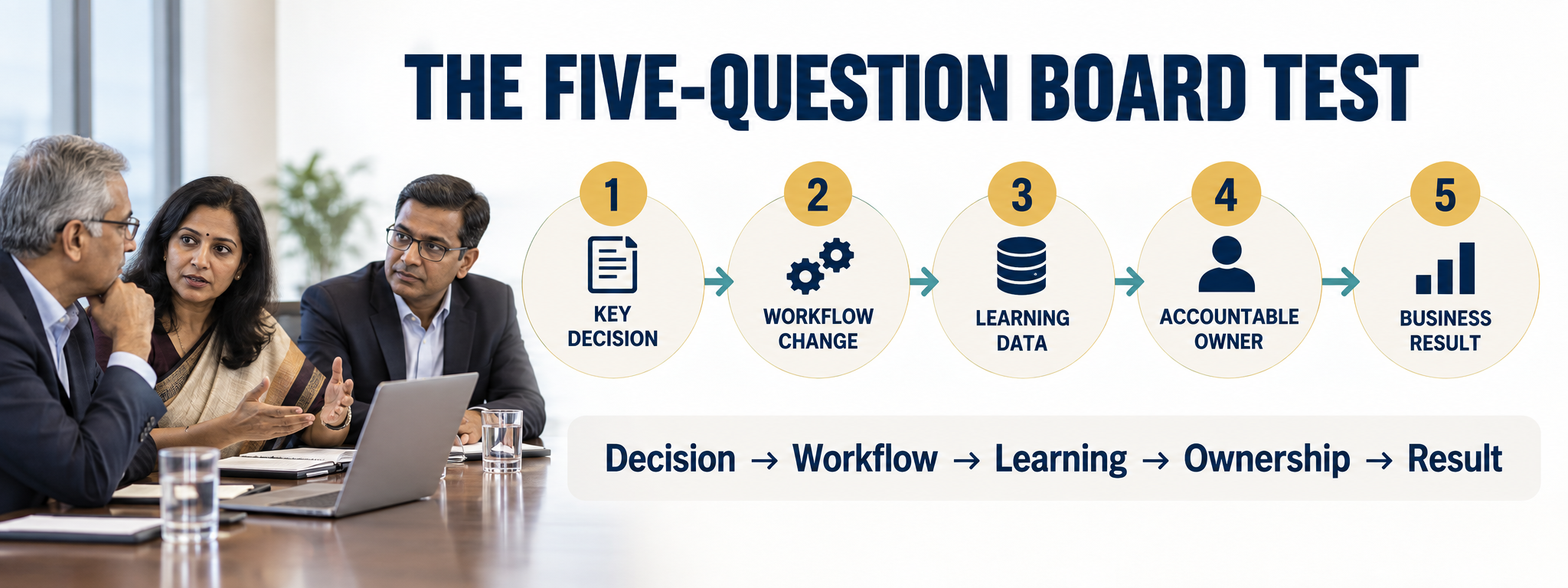
Before it approves the next AI budget, a board can ask five questions:
- Which key decision will change? Name the choice and leave the tool aside.
- How will the work change? State which steps will end, shift, or move to staff who handle exceptions.
- How will the system learn? Show how results, corrections, and overrides will return to the database.
- Who is still accountable? Name the business owner and set the rules for human review.
- Which result will prove that the change worked? Track time, errors, risk, use, or customer results. Launch counts do not prove value.
Weak answers point to an AI-using project. Strong and linked answers show a move toward an AI native enterprise.
This test also shows what must come first. Poor feedback signals a data problem, and the lack of a clear owner signals a control problem. If the work itself has not changed, leaders face a design problem; if staff make little use of the system, they face a skills and change problem.
Build an AI Native Enterprise With Care
AI-native design assigns autonomy selectively. The right level of machine action depends on the harm a wrong choice may cause. It also depends on how well the system works and whether an error can be reversed.
For low-risk work that is easy to undo, teams may allow more machine action. By contrast, credit, jobs, safety, health, and rule-bound choices may still need strong human review.
Therefore, start with selected workflows. Pick one where the value is clear, the data is sound, and an owner can be named. Then learn from that use before you give the system more scope.
This path may look slower than a rush of pilots. In practice, it gives the firm a better route to scale. The company develops controls, data, skills, and redesigned workflows together.
The Decision That Matters Now
Most large firms will use AI. That alone is no longer a source of real distinction.
The key divide will be between firms that add AI to the old company and those that redesign the company around better choices. Leaders can start with one part of the firm, choosing an area where AI native work can create an edge that rivals cannot easily copy.
Begin with the five-question test above. Then explore AI Central’s Enterprise AI Transformation analysis for more on strategy, work design, and leadership. You can also register your interest in AI Briefing for concise updates as the service develops.


